Showing posts with label set up company in Singapore. Show all posts

Thursday, September 28, 2017

Plan Your Company Incorporation in Singapore & Let it Grow


The Q1 & Q2 2017 reports relating to the Singapore business environment are promising. They have kindled the hope that the economy as a whole will beat the expectations and grow at a faster rate. Isn’t it the right time to find the best incorporation services Singapore for your company incorporation Singapore? The following are a few key points to nurture a newly started company in Singapore.

Keep a Keen Eye on the Market Trends

To grow your new company incorporation in Singapore, you need first to know, how the wind is blowing in the market. Keep a careful watch on the things happening in your niche. That is the way to spot opportunities and to market your products or services.
Invest in market research which will tell you where your competitors are lagging behind. It will also reveal the customer needs that you can fulfill. Create a realistic business plan and execute it. Be prepared to reinvent and align your products to meet the customers’ expectations.
Go online and search for resources like Future Ready Singapore & Singapore Economic Development Board platform. It will help you to keep in touch with the latest market news and opportunities.

Networking Through Right Business Partners

For a new company incorporation Singapore, the easy way of growing its reach is to strike a partnership with an established player. Find reliable and reputed retailers, distributors, franchisees, or local representatives who can open their channels for your products or services. Put in extra efforts to stay in touch with them for their inputs and market information.
Do your research and try locating a company that is ready to collaborate with you. Such business matching opportunities can be really useful to a new company incorporation in Singapore. Visit the websites run by organizations like Singapore Business Federation (SBF) or Singapore International Chamber of Commerce (SICC). Their sites list the companies interested in business matching & networking opportunities.

Go Digital, Market Your Idea to Netizens

For Singaporeans, being digitally connected is a way of life. A business that is preferring to stick to the traditional ways is soon going to have to deal with difficulties. Go digital! You can, for a small investment in a business website, increases your reach to the level of big players.
In the digital world, the field is level for all players. Use social media marketing to your advantage. Market & sell your products in the digital space.

Leverage Affordable Business IT Solutions

Business software systems like payroll, accounting, attendance, inventory, etc., allows you to automate your internal processes. It saves time and the suboptimal use of the costly human resources. Use trusted software that is available in public domain or download free copies from the reliable software manufacturers. Doing so will leave enough time at your hand to go out and find the loyal customers.
Well, the time is ripe & the business sentiments are positive. It waits for no one, and certainly, it will not pause in its strides for your company incorporation Singapore. If you are still contemplating a dive into the Singapore startup scene, you need to hurry to make it good. Trust one of the reputed incorporation services Singapore to start your company.

Also Read:https://www.sbsgroup.com.sg/blog/private-limited-company-singapore-a-comprehensive-registration-guide/

Tuesday, September 12, 2017

Singapore Company Registration: Everything You Need to Know

So, you are ready to set up a company in Singapore. Are you sure about the ins and outs of Singapore company registration process with ACRA (Accounting & Corporate Regulatory Authority)? Which type of entity should you prefer? What are the pre-requisite conditions for registration? And, ultimately, “Why incorporate with ACRA?” These are the questions that linger in your mind when you plan to set up a company in Singapore.

This blog excerpt will outline everything you need to know about company registration Singapore, right from the procedure of incorporation to legal requirements.

Which Type of Company to Incorporate in Singapore?
Private Limited Company is the most common and preferred type of company that majority of entrepreneurs choose for incorporation. The reason behind this preference is the various benefits the private limited company has to offer. Tax efficiency, scalability, credible image, legal identity, etc. are the few of the advantages of the private limited company in Singapore.

Nevertheless, the compliance requirements for the company is comparatively complex than many other business structures like sole-proprietorship and Limited Liability Partnerships. Filing of annual returns, maintaining financial statements, XBRL filing and holding of AGMs (Annual General Meetings) are to name a few. Even the process of winding up of a company is bit tedious and time-taking. Despite these limitations, the majority of entrepreneurs opt to incorporate their business as a private limited company due to its manifold advantages.

A Few Things to Take Note of Before Company Registration

  • Director: There is no limit on the numbers of the director in a Singapore company. But, at least one local director should be appointed. He has to be either a local resident (citizen or PR) or holder of Employment Pass. He/she must be of minimum 18 years and above. Also, the director must not have any previous record of bankruptcy or criminal conviction. Non-shareholder can also become a director of a company.
  • Shareholder: A Singapore company must have the minimum of one shareholder. The maximum number of the shareholder can be up to 50. As per the law, 100% local or foreign shareholding is allowed in a Singapore company. A shareholder can either be an individual or entity. The issue of new shares and transfer of existing shares can be done even after company incorporation.
  • Paid-up Capital: The minimum paid up capital required for Singapore company registration is S$1. The amount can be raised any time after incorporation. There is no concept of authorized capital in Singapore.
  • Registered Office Address: There must be one local registered office address. It can be either commercial or residential address. You must take prior approval from the authorities like HBD or URA for using HDB and private properties respectively. Please note that P.O. Box address is not allowed.
  • Company Secretary: The appointment of a qualified company secretary is mandatory for all Singapore-based company as per the local jurisdiction. It has to be done within six months from company incorporation.


Singapore Company Registration: The Process
The process of company registration Singapore is acclaimed to be one of the easiest and straightforward in the world. It involves just two simple steps- company name approval and company registration (filing of application form). The complete process is computerized. It takes very less time to get a company registered with ACRA in Singapore as long as the applicant adheres to the laws and regulations.

Company Name Approval
One must have two to three proposed company names and get one company name approved by the authority, i.e., ACRA. You can search over the ACRA’s website to know the availability of the company name. More often than not, it takes very less time to get the name approved unless the application requires the approval of the external authority.

Follow the below-stated tips to improve your chances of fast company name approval.

• Unique name, not identical or similar to any existing company name.
• It must not violate any copyright law or trademarks.
• It is not obscene or vulgar

An approved company name will remain reserved for 60 days from the date of application. Ideally, the company registration process must be done within this period. You can appeal for an extension of the reserved period for another 60 days before the expiry date.

Singapore Company Registration: Final Step
Once your company name has been approved, you can proceed for filing the application form along with required documents. The necessary documents include share details, registered address details, particulars of directors, shareholders, company secretary, Memorandum & Articles of Associations.

Upon successful submission of the application form, you will receive an email from ACRA notifying about your Singapore company registration. The email will contain incorporation certificate along with the UEN (Unique Entity Number). The email will be treated as the official incorporation certificate.

Also, be sure to fulfill the post-registration formalities before commencing the business operation.


Thursday, September 7, 2017

How Important is a Good Credit Score for Your Business after Singapore Company Registration?

Money is the lifeblood of every business. No one can start a business without having a considerable amount of money. So, if you are planning to get your feet wet in the business by applying for Singapore company registration, make sure to have an enough capital fund in your hand. You may accumulate the required capital either by securing a loan from bank, creditor or private financial centers. Fortunately, there are plenty of funding assistance programs from Singapore government for start-ups. However, maintaining good credit score is important for your business venture. 

You cannot fund your startup independently unless you are a filthy rich person. 
Securing a loan is the best way to get the business started. The first question any money lender or creditor will ask you is “What is your credit score?” Your credit score will reveal your financial standing. They will come to know how good you are at managing the money? Your credit score will play a vital role in deciding whether to approve the proposed loan or not. Thereby, if you are planning for company registration Singapore to run a business in the city-state, make sure to maintain a good personal credit score. 

Singapore Company Registration

Know What goes into a Good Credit Score
You would not be able to maintain a good credit score unless you know what goes into a good credit score. Try to know how to calculate the credit score. There are a few key elements are taken into the consideration when calculating the credit score – Your Payment history, credit age, level of debt, etc. 

Pay Your Bills on Time
Paying bills on time is paramount to build and maintain a good credit score.
Credit scores are calculated by what is in your credit report. If you are bad at paying bills, it adversely affects your credit score. Since bill payment history determines your credit score, make sure to handle this aspect carefully. 

A solid bill payment history lets the lender or creditors know that you have enough cash to manage your expense. It increases the chances of securing a business loan to set up a company in Singapore. You may avoid the late payment by signing up for automatic payments. If you are running short of money to make the payment, the least you can do is to pay the minimum due amount to manage the total outstanding on a monthly basis. However, if you have the sufficient amount of money, never go for the minimum due amount. 

Manage Your Debt
All kinds of debts including credit card balances, loan balances or lines of credits affect your credit score. Having more debts can reduce the credit score and make it difficult to manage your monthly payments. The lower your debt, the easier will be to gain a good credit score. 

Minimize the Credit Usage
The higher the credit limit usage is, the worse your credit score will be. Your credit balance should be as low as possible to maintain a good credit score. For the creditors, you are a riskier borrower if you exceed the credit limit. It reduces the chances of getting the business loan approved. 

So, if you want to fulfill your dream of company registration Singapore, make sure to maintain a good credit score by not letting your credit debt exceed the limit. If you are facing problems in maintaining the ratio, you better take some time to pay off the excess amount and raise the credit score. Once your credit score improves, you can approach to any lender for obtaining the loan. 

Watch Your Credit Reports
Keeping track of your credit report is essential when you plan to do business in Singapore. Just because the reports are done by the professionals does not mean it will be flawless. Errors in the report may lead to dropping credit score at your end. Fraudulent activities like identity theft and credit card fraud may lead to inaccurate data on your credit report. Thereby, keeping a constant eye on the report is a must to avoid errors. If any error appears, make sure to rectify them as soon as possible. 

Do not let poor credit score ruin your dream of Singapore company registration. Make sure to follow the tips mentioned above to bolster your chances of obtaining a business loan by having a solid credit score. You may also take the assistance of expert like SBS Consulting to pave a way towards success.

Contact Info:
SBS Consulting Pte Ltd
Visit: https://www.sbsgroup.com.sg/
High Street Centre,
#17-02, 1 North Bridge Road,
179094 – Singapore
Phone: +65-6536 0036
Email: info@sbsgroup.com.sg

Thursday, August 31, 2017

Different Types of Company Incorporation Singapore & Which One Suits You Best

So, you are convinced to incorporate a company in Singapore after doing plenty of research and due diligence on the market. Now, it is important for you to know the type of company or business structure that the jurisdiction has. You must pick the best and right one for your company incorporation Singapore process.

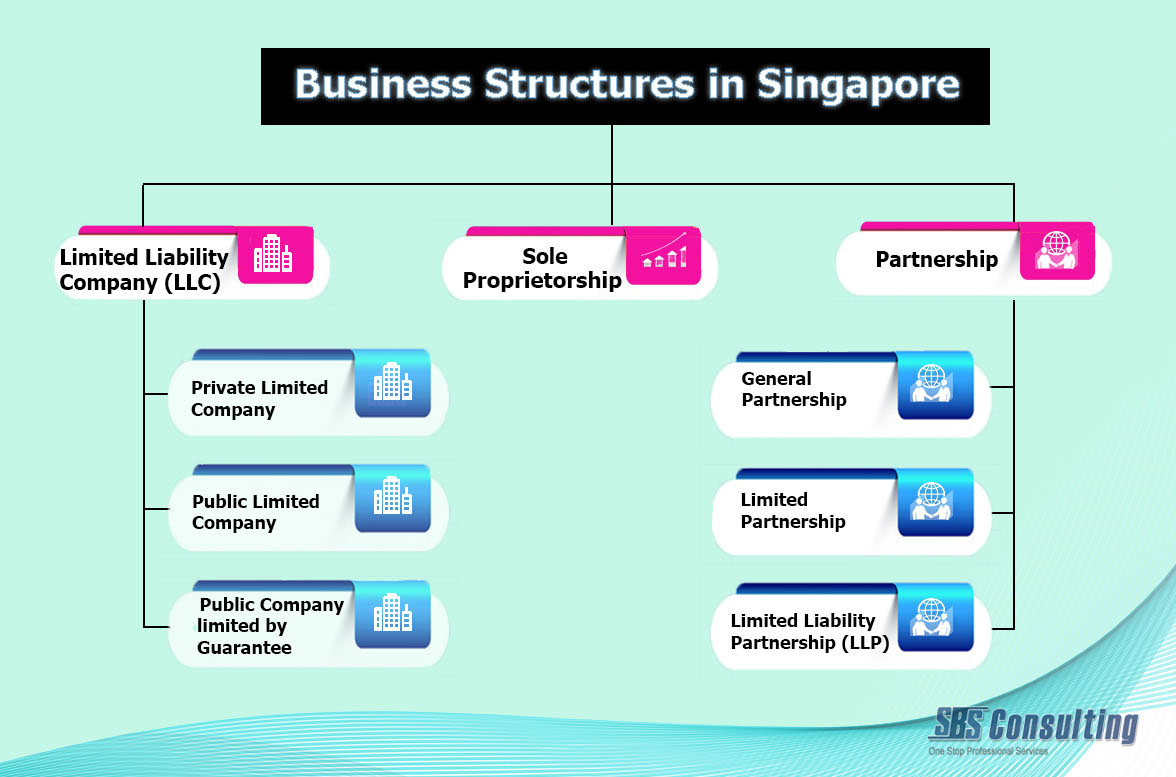
There are mainly five types of business structures in Singapore.
  • Company (Limited Liability Company)
  • Sole Proprietorship
  • Partnership
  • Limited Partnership
  • Limited Liability Partnership
Being a home to so many heterogeneous industries, multi-national companies, etc., the legal framework of Singapore allows you to register your business in any of the business entity types. Nevertheless, you must make sure to take the decision carefully as it will have a lasting impact on the liability of the owners, taxation policies, financing & expansion potential, the ability of transfer, etc.

This blog excerpt will outline the details about the various types of business entity in Singapore so that you can easily select the best and most suitable structure for your upcoming venture.


Limited Liability Company (LLC)

An LLC is a company limited by shares. The liabilities of the company are limited to the amount of share capital. It is registered under the Singapore Companies Act with authority called ACRA (Accounting & Corporate Regulatory Authority). There are three types of company in Singapore.
  1. Private Limited Company
  2. Public Limited Company
  3. Public Limited Company by Guarantee
Private Limited Company: The private limited company is an LLC where the maximum number of shareholders is 50. Shares are held privately and not available for general public. Majority of entrepreneurs choose private limited company as the best option for their Singapore company incorporation journey. It is the most advanced, scalable and tax-efficient structure in Singapore. These factors drive entrepreneurs to select this very business entity. The below are the advantages of private limited company.
  • A private limited company has its own legal identity, district from its members (shareholders and directors).
  • The liability of the shareholders is limited to the amount of money they invested in the company.
  • Raising capital is easy. It can be done by bringing in new shareholders or issuing more shares to existing shareholders.
  • Credibility image of a private limited company is better than other structures like the sole proprietorship, partnership, and LLP.
  • Perpetual succession. The company continues to endure even after the separation of any of the member.
  • Ownership of the company can be transferred either wholly and partially.
  • The tax benefits and allowances for the private limited company are plenty.
Public Limited Company: The shares of the public limited company are available for general public. It is a type of LLC. The minimum number of shares of a public limited company is 50. Usually, this type of company is listed on stock exchange, and they are meant for large businesses. So, it cannot be your right pick.

Public Limited Company by Guarantee: It is meant for non-profit organizations like NGOs, associations, societies, etc.

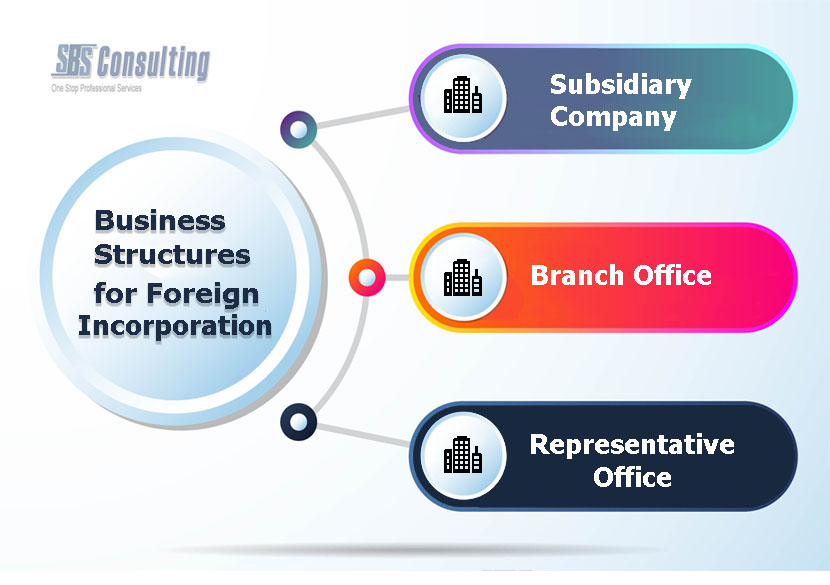
There are types of company incorporation options available for foreign entities.
  1. Subsidiary Company: A Singapore subsidiary is a private limited company whose major shareholder is a foreign company. Nevertheless, it is distinct from its parent company.
  2. Branch Office: A branch office is a mere extension of its parent company.
  3. Representative Office: It is temporary set up for conducting market research related activities to explore the potentialities. A representative office is not a legal entity and cannot conduct any business activities.
Sole Proprietorship

A sole proprietorship is a business structure owned and managed by a single owner. It is the simplest form of business formation in Singapore. The owner and the business are same. The owner will bear all the expense and liabilities incurred by the business. It is prone to financial risk. So, it is not recommended for serious entrepreneurs.

Partnership

A partnership business is owned by two or more partners. It has no legal identity and thus, not separate from its partners. The existence of the firm depends on the member. It comes to an end with insolvency, retirement or death of a partner. There are three types of partnership.
  1. General Partnership - Each partner can be held liable for any misconduct or any wrong actions of another partner.
  2. Limited Partnership - There will limited partner with general partner. The liabilities of the limited partner are limited to the amount of capital they have invested in the partnership.
  3. Limited Liability Partnership - Out of three partnership structures, LLP is the most advanced and latest partnership in Singapore jurisdiction. The features of an LLP are the combination of partnership and company. An LLP is meant for professionals like the accountant, lawyer, architect, etc.
Decide the final business structure for company incorporation in Singapore based on your specific goal, situation, plan, and budget. You can even take the assistance of an expert to make the selection process highly effective and sound.

Contact Info:
SBS Consulting Pte. Ltd.

Visit: https://www.sbsgroup.com.sg/
High Street Centre,
#17–02, 1 North Bridge Road,
Singapore — 179094
Tel: (65) 6536 0036
Email: info@sbsgroup.com.sg

Wednesday, August 23, 2017

Company Incorporation Singapore & Funding Options

Singapore is renowned as an advanced business hub of the Southeast Asia. The country prefers trade economy. By virtue of its geographical location, planning and lots of hard work, it has come up as the Entrepot linking the East and West. It continues to attract the foreign investors and the business owners who are eager to do their company incorporation Singapore.

Is it fashionable to Start a Business in Singapore?

The country offers one of the lower tax rates to the corporate, and individuals. This has attracted thousands of foreign companies, a large majority of which are MNCs and SMEs, to its shores. A number of these companies have entered Singapore market to capitalize on the opportunities present in the emerging markets of Asia.

A company incorporation in Singapore enables these companies to keep in touch with the 2.4 billion prospective customers that are inhabiting Asia. However, starting a business in Singapore means facing stiff competition before achieving business growth. The local and foreign individual entrepreneurs & the companies have options in business structures they can use to start a company in Singapore.


 Setting Up a Company in Singapore

A) For Singaporeans & Local Companies

In Singapore, an individual (local as well as foreign) above the age of 18 years can opt for company incorporation Singapore. According to the norms, the individual should not have history of bankruptcy, etc. The local corporate entities can also opt for Singapore business formation.
The individual entrepreneur or a company can choose one of the following business structures for their Singapore company registration. They need to apply to the ACRA (Accounting and Corporate Regulatory Authority) which acts as the Company Registrar of Singapore.
  • Private Limited Company (Pte Ltd)
  • Limited Liability Partnership
  • Sole Proprietorship
The process for company incorporation Singapore is easy and gets over fast unless the application is referred to the external authority due to some reason. The private limited company is by far the most favored business structure by the business owners both, individuals and corporate.

B) For Foreign Companies

A foreign corporate can use one of the following business structures for its company registration Singapore. Singapore allows a foreign individual or company to own 100% shares in the new company. ACRA advises foreigners to hire incorporation services providers like SBS Consulting for the task.
  • Subsidiary Company
  • Branch Office
  • Representative Office
Key Pre-Incorporation Requirements

Before we could initiate the process to register your private limited company in Singapore, you need to fulfill the following conditions:
  • Registered company name
  • At least 1 ordinarily resident director
  • At least 1 shareholder
  • At least 1 company secretary
  • Minimum paid-up capital of S$1 (S$50,000 for EntrePass holders)
  • Local registered address for company office
The foreigners can choose to relocate to the Singapore and act as the local directors of their companies after its incorporation. However, they need work passes such as Employment Pass or Entrepreneur Pass to work in Singapore. Alternatively, they can stay at their home but then, they must hire nominee local director services to fulfill the criteria.

Documents Required for Singapore Company Registration

Along with the application for company formation Singapore, the business owners need to submit few documents. They are listed as follows:
  • Registered name of the proposed company
  • Details of intended business activities
  • Details of shareholders and directors
  • Registered local office address
  • Details of company secretary
  • Memorandum and Articles of Association (M&AA) for the proposed company
  • Singapore residents must submit a copy of their identity card
  • Foreign entrepreneurs must submit a copy of passport, proof of overseas residential address, KYC details, a personal & business profile
  • Foreign corporate must submit a copy of certificate of incorporation and company constitution
Post-Incorporation Requirements

After the successful company registration, ACRA sends an email containing the Certificate of Incorporation to its owner or the hired incorporation services provider. The message contains the Unique ID number of the new company. Our expert, on payment of required fee, can get the hard copy of the certificate of incorporation and business profile of the company from ACRA.
  • SBS assists the owners of the newly minted company in opening a corporate bank account in any bank in Singapore. It is a necessity for the proper handling of the financial transactions & streamlining the cash flow of the company. It also helps, in the long run, in segregating the owner’s personal finance from that of the company’s.
  • Before starting company’s business activities, the owner needs to check whether it needs any licenses or permits. The experts at SBS Consulting could apply on their behalf to the appropriate authorities and do the needful.
  • We also provide assistance to register the new company with the CPF Board and top-up its account. In addition, we also assess the need to register the new business for GST (Goods and Services Tax). If it is expecting to cross S$1 million in annual turnover, then our advice is to register it for GST.
Funding Options Open to Singapore Companies

Singaporean authorities are very much interested in seeing their startups succeed. It is one of those countries that are actively supporting their innovative and creative individuals in starting with the right foot in the business arena.
Singapore has multiple grants, schemes, and other programs to offer to the entrepreneurs opting for Singapore company registration. It is one of the markets where the businesses can rely on lower tax rates, multiple DTA agreements, and tax benefits that are tasked with keeping their overheads low.

Grants and Schemes for the Singapore Startups

Singapore businesses, right from the incubation period, can investigate multiple funding options that are available to them. There are various schemes supported by the government agencies for the purpose.

  • ACE Startups Grant
  • Accreditation@IDA
  • Industry track for A*STAR scholars
  • Smart Nation
  • IDM Jump-start and Mentor (i.JAM)
  • JTC LaunchPad @ one-north
  • MOOC Pilot for Data Sciences & Analytics Training
  • Productivity and Innovation Credit (PIC)
  • Sector Specific Accelerator (SSA) program
  • Technology Enterprise Commercialisation Scheme (TECS)
  • SPRING SEEDS
  • Technology Incubation Scheme (TIS)
  • Early Stage Venture Fund (ESVF)
  • Business Improvement Fund
  • Workforce Development Authority (WDA) subsidies
  • Innovation & Capability Voucher
  • ComCare Enterprise Fund
  • Capability Development Grant
  • Fast-Track Environmental and Water Technologies Incubator Scheme
  • Technology Incubation Scheme (TIS)

In addition, Singapore business owners can expect financial support from the entities like Angel Investing Networks, Venture Capital Firms, Private Equity Firms, etc.

Angel Investing Networks

The term ‘Angel Investors’ covers individuals or groups that are interested in backing startups in their earlier stage. The startups, especially those having untested business model, find these individuals useful when they need quick access to finance. The following is a short-list of angel investors operating in Singapore. 

  • Business Angel Network South East Asia (BANSEA)
  • Business Angel Scheme (BAS)
  • Singapore Angel Network (SGAN)

Venture Capital Firms

The startups that do not have access to capital market choose to go to the Venture Capital firms. These are groups of investors that finance startups and small businesses that they believe are great for long-term investments. In reality, the investment may turn out to be a high-risk investment. The following is a list of venture capital firms in Singapore.

  • Singtel Innov8
  • KK Fund
  • East Ventures
  • Golden Gate Ventures
  • Fenox Venture Capital
  • IMJ Investment Partners
  • Ardent Capital
  • Jungle Ventures
  • Sequoia Capital
  • 500 Startups
  • Life.SREDA
  • Singapore Venture Capital & Private Equity Association

Private Equity Firms

Singapore businesses having a very positive bottom-line can go to these entities for the finance. These are no risk-takers, rather, they believe in backing well-established and profitable performers experiencing high-growth rate. The following is a list of such entities you can find in Singapore.

  • 3V Source One Capital
  • Venstar
  • Navis Capital Partners
  • AIF Capital
  • Tael Partners
  • L Capital Asia

Singapore really believes in its startups and SMEs. The authorities understand the role these entities play in keeping the unemployment rate down. It is the main reason why they support an energetic startup ecosystem. Last year, the startups raised more than S$3.5 billion in investment from the VC’s and private equity firms. There were successful IPO’s and acquisitions.

Singapore Taxation 

Singapore corporate tax rate (0%-17%) is also considered as one of the most affordable. Moreover, the Singapore registered startups benefit from the tax exemption scheme specially designed to keep their overheads down in their initial days. They get full tax exemption on their chargeable income of up to S$100,000.
The existing companies also benefit under Partial Tax Exemption scheme. The dividends disbursed by the companies to their investors are tax-free because Singapore does not practice capital gain tax. The country also ranks high for the ease of paying taxes.

Singapore is a fully geared business environment that offers excellent network connectivity, extensive sea routes and reliable air links, modern infrastructure, dependable transportation system, secure environment, world-class education, etc. It is easy to see why entrepreneurs from all over the world opt for company incorporation Singapore. Indeed, the little island is a great place for doing business.

Monday, August 21, 2017

Company Incorporation Singapore: Selecting Right Business Structure

The ease of doing business, compliance responsibilities, scalability, tax rates, liabilities, ease in transfer of share, investors’ queries & expectations affects the choice of the business structure for a company incorporation Singapore. It is a tough call to take as choosing the right business structure to suit the present and future need of the company is a challenging task for even the experienced business owners. It can impact a business’ viability, growth, and future expansion.

Choosing the Best Business Structure

The individual entrepreneurs can choose Sole proprietorship, Private Limited Company or one of the forms of Partnerships to start their Singapore companies. First, they need to go through the advantages, disadvantages and nature and scope of each of these business structures before judging their usefulness for the business purposes. There are trusted corporate services providers in Singapore who assist their clients in dealing with the dilemma.

The information presented here will assist you in figuring out the most suitable business structure for your business. It is also useful to the owners of the existing businesses who are thinking of converting to a more dynamic legal form.


Your choice has the full potential of affecting the fate your business. It can impact your taxes, personal liability, brand image, credit, and the opportunity to exploit your business idea to its fullest. It can ruin your breakthrough plan, sustainability of the business, and can lead to the premature death of your business.

Business Structures for Individual Entrepreneurs

A local or foreign individual above the age of 18 years can opt to form a Singapore company. The process for company incorporation in Singapore is fast and hassle-free. You should prefer a particular business structure for the setting up of your Singapore company based on the magnitude of the business idea (whether it is a product or platform), the scope of the business plan, and the scale of your intended business activities. You also need to determine your liability, tax obligations, cost and appreciate your business assets before taking the final decision on the structure to incorporate.

Limited Liability Company (LLC)

Limited Liability Company in Singapore is a legal construct that limits the liability of the shareholders of the company to their capital invested in its shares. The private limited company, public limited company, public limited company by guarantee and subsidiary company are the examples of the LLC in Singapore.

ACRA (Accounting and Corporate Regulatory Authority) acts as the Company Registrar for Singapore. You need to apply to the ACRA to register your new business under the Singapore Companies Act, Chapter 50.

1)  Private Limited Company (Pte Ltd)
A private limited company is the most favored business structure for Singapore business formation. It is a type of LLC. Its shareholders (owners) can be from 1-50. At least one of the director needs to be ordinarily resident of Singapore. Singapore corporate income tax
  • An individual above the age of 18 can opt for company formation Singapore.
  • A private limited company has a separate legal identity from its owners.
  • A private limited company is a legal person and has the rights of a natural person.
  • It can buy property in its own name.
  • It can sue or be sued in its own name, which keeps the shareholders out of the courts of law.
  • The private limited company has perpetual existence. It is not tied to any particular member or shareholder.
  • The shareholders are not responsible for the loss or debt incurred by a Pte Ltd.
  • Singapore allows 100% foreign ownership.
  • Transfer of ownership is easy.
  • The name company must include the terms ‘Pte Ltd’ or Private Limited.
In general, a private limited company has more credibility than a sole proprietorship or a partnership in the eyes of investors, banks, financial institutions, suppliers, & customers. The perception matters when a Pte Ltd company goes to the market for securing loans for its expansion.

A Singapore private limited company is considered as a local company and tax resident. It gets access to all tax benefits and incentives schemes for the local entities which go a long way in reducing its operating costs and tax payable. The headline corporate tax rate is 17%. However, the tax paid by the local companies is much less.

2)  Public Limited Company
A public limited company is a type of LLC which is listed on the stock exchanges. The general public can buy its shares or debentures. The number of its shareholders is more than 50.

3) Public Company limited by Guarantee
A Public company limited by guarantee is a form of LLC. Most often, these are started to promote the non-profit causes. The non-profit organizations, trade associations, clubs, charitable & religious bodies, and professional societies are its best examples.

Sole Proprietorship

In the eyes of Singapore Company Law, a sole proprietorship is not a separate legal entity from its owner or proprietor. It is not an incorporated company and it is regarded as a business firm. Because of this,
  • The owner has to deal with unlimited liability for the debts and losses incurred during the course of its business activities.
  • A sole proprietorship cannot buy properties or real estate in its own name.
  • They need to be in the name of its proprietor who is required to pay property tax on it from their own pockets.
  • Its income is considered as that of its owner who has to pay personal income tax (0%-22%) on it. It is costly when compared to the corporate income tax (0%-17%).
  • The proprietor also finds it taxing to raise funds for the expansion of the business activities.


Partnership

Singapore Company Law allows two or more entities (individuals and corporate) to come together and register a partnership. The business structure allows the business owners with the complimenting skill sets to come together & conduct their business activities to earn a profit. It can have 2 to 20 members (partners). The members of the partnership need to pay personal income tax on the income received from its business activities. There are 3 types of partnership.

1)  General Partnership

A general partnership closely resembles to the sole proprietorship business. These firms share the same handicap when it comes to the personal risk & liability of their owners towards the debt or losses arising out of business activities. This type of partnership holds, all the partners liable for its losses or debts irrespective of their involvement.

2)  Limited Partnership

A limited partnership differentiates its members as General Partners and Limited Partners. There is no limit on the number of partners it can have, but it needs at least one general partners and a limited partner. The liability of the limited partners is only up to the amount specified in the partnership agreement. However, the liability of the general partners is unlimited.

3) Limited Liability Partnership (LLP)

An LLP is the most favored form of partnership by the business owners. It combines the features of a partnership and a company. A group of two or more qualified individuals having complementing skills prefers to form this type of partnership. This partnership form determines the liability of its owners based on their actions or inactions.
  • The LLP has separate legal existence from its owners.
  • Its owners need to pay personal income tax (0%-22%) on the income received from it.
  • They chose this form because like a private limited company it limits their liability to some extent.
  • Its debts or the losses are attributed to the partners because of their carelessness, actions or inactions leading to the losses to the partnership.
  • The uninvolved partners are spared from the responsibility.
  • An LLP is best suitable for professionals like charted accountant, lawyer, architect, etc.
Business-Structures-in-Singapore

Business Structures for Foreign Incorporation

Singapore, in addition to the individual entrepreneurs, also attracts foreign businesses. Especially, the SMEs, wanting to expand their horizons opt for company incorporation Singapore. These entities have the option of choosing one of the following business structure.
  • Subsidiary Company
A subsidiary company is a form of limited liability company. It is preferred by the foreign corporations to setup their company in Singapore. It has a separate identity from its parent foreign corporate. One of its USPs is that the Singapore authorities allow 100% foreign shareholding. In most cases, the foreign corporate acts as the major shareholder.

A subsidiary company is considered as the local company. It has access to the tax benefits, exemptions, and rebates awarded by the local authorities. It is responsible for its own debts and losses arising out of its business activities. The parent company’s liability remains limited to the capital it has invested in the shares.

  • Branch Office
Registering a branch office in Singapore is yet another option that the foreign corporations can choose. A branch office is not considered as the local company. It is treated as the extension of the foreign parent company. It means its management has to follow the Memorandum and Articles of Association (MAA) of the parent company to deal with issues like shareholding, business activities, and structure.

As a branch office is not a separate legal entity from its parent company, the liability of its debts and losses arising out of its business activities lies with the parent company.
  • Representative Office
The foreign corporate likes to survey & research the new markets before committing their resources to establish their presence in it. In Singapore, they need to register a representative office to carry out such activities.

A representative office has no legal status. It is taken as just a temporary administrative arrangement of its parent company. According to the Singapore Companies Act, it cannot indulge in any business activities.

Business Structures for Foreign Incorporation

Steps in Singapore Business Incorporation

Registering a Singapore Company: The process to register a Singapore company is straightforward and comprises only 2 procedures; a) Registering the company name with ACRA and b) Applying to register the company. It is a speedy process, and you can start a company within no time unless the application gets referred to the higher authorities for this or that reason.

Key Pre-Incorporation Requirements for Pte Ltd

However, you need to complete the following pre-incorporation requirements before applying to ACRA to setup your company in Singapore.
    • At least one shareholder
    • Minimum initial paid-up capital of S$1 (S$50k for EntrePass holders)
    • At least one local resident director
    • At least one company secretary
    • Registered local office address

Singapore Tax Regime

Singapore offers one of the most affordable tax structure to individuals and corporate. The corporate tax rate is between 0%-17%, and the personal tax rate is between 0%-22%. The tax rates are considered as one of the lowest in the world and attract business owners from all over the globe.

The lack of capital gain tax in Singapore attracts global investors in their droves. It means the dividends distributed by the Singapore companies to their investors are tax-free. In addition, the Singapore companies have access to many tax incentives, rebates, exemption schemes, etc. It is one of the reasons established foreign businesses opt to set up their Singapore companies.

Singapore has opted for the trade-based economy. Its geographical location is rightly conducive for it to act as an entrepot between the East and West. For the business owners opting for a company incorporation Singapore, the country offers stringent Intellectual Property laws, state-of-the-art infrastructure, advanced transport network, quality health care, pro-business environment, excellent education system, multilingual & talented work force. It is a society free of corruption led by the stable and open government committed to providing quality life to its citizens.

Originally Posted: https://goo.gl/AVBv9Q

Friday, August 18, 2017

Hidden Facts about Company Incorporation Singapore


Company incorporation Singapore is the first step you must need to take when starting your business activities in the jurisdiction. Ignite your passion towards entrepreneurship by taking the plunge. If handled efficiently, your business will be bound to yield a good amount of revenue. 

You might be wondering, why only Singapore for company incorporation? Why not other jurisdictions? The Republic is one of the easiest places for doing business. As per the prestigious World Bank report “Ease of Doing Business,” Singapore ranked one of the top positions for more than ten years now. This accolade is enough to justify the reputation Singapore has earned in these years. 

Nevertheless, before keeping faith into company incorporation in Singapore, you must know a few vital facts about the process. Here are the few facts you should keep in mind. 

company incorporation singapore

Singapore Jurisdiction is Stringent

When you opt to incorporate a company in Singapore, you must follow certain obligations laid down by the authorities. Accounting & Corporate Regulatory Authority (ACRA), the national regulator, oversees the process. It is the Singapore Companies Act, Cap 50, that governs the company incorporation process. There are some minimal requirements and necessary documents which must be met and furnished during the process of incorporation. Since the authority is stringent, there would not be any consideration for delay and non-compliance. 

Cost of Singapore Company Incorporation
 
The cost of company incorporation Singapore has been specified by the authority i.e. ACRA. The fee has to be paid during the process of filing application for registration. If you want to enjoy a hassle-free incorporation, you can hire a complete package of company incorporation from trusted firm like SBS Consulting. The firm offers an attractive package of incorporation at S$699. It comes with free services of the corporate secretary and registered address for first one year. The fees of the firm are highly competitive in the market. 

There is Minimal Bureaucracy 

The process of Singapore company registration is divided into two simple steps: 1) Company Name Approval and 2) Company Registration (filing of the application form). Both of the steps have been computerized and thus, can be done online. It is a quick, straightforward and simple process. Since the entire process can be done electronically, the involvement of bureaucracy is very minimal or zero. There are kiosks in premises of the ACRA’s office, and also, the official website that can be used to get the registration done. 

Fulfilling Minimum Requirements of ACRA

Reiterating, the applicant must meet a set of minimal requirements put in forth by the ACRA before applying for company registration. Here is the list of minimal requirements.
  • The Approved Company Name (it must be approved by ACRA)
  • One local director who is an ordinarily resident in Singapore (Citizen, PR or holder of Employment Pass/ EntrePass)
  • Minimum 1 or maximum 50 shareholders should be there
  • A local registered office address is must
  • Minimum paid-up capital is S$1
  • A local company secretary must be appointed within six months of company incorporation
The process of company incorporation in Singapore would be completed unless you fulfill all of these requirements. 

Singapore Taxation System is Pro-business

The taxation regime of Singapore is deemed to be one of the attractive and progressive policies in the world. It follows single tier tax system. The revenues of the company are taxed at corporate tax rate (headline rate is 17%). The dividend earned by the shareholders are tax-free as there is no capital gains tax. 

A web of more than 70 Double Tax Agreements saves the tax payer from paying tax in more than one country. Plus, implementation of full tax exemption scheme is an added advantage for startups. It allows startups with tax-free income for first three years if their annual revenue is less than S$100,000. Also, the existing and new companies whose annual revenue ranges between S$100,000 to S$300,000, will be taxed at the tax rate of 8.5%.
 
Annual Compliance Requirements

As stated earlier in this blog, the Singapore jurisdiction is very strict about its laws and regulations. You will be required to comply with a set of annual compliance requirements such as hosting AGMs, filing Annual Returns, preparing financial statements, GST return filing, XBRL reporting, etc. Make sure to meet all the requirements in order to avoid the legal actions of the authorities. 

Singapore enjoys a reputation of being the leading business hub in the Southeast Asian region. There are many attributes which contributes to the reputation of the Republic. These attributes drive many global entrepreneurs to come and start their business in the soils of the island country. Tax benefits, forward looking policies, pro-business ecosystem, world-class infrastructure, talented workforce, etc. are to name a few. 

Since the process of company incorporation Singapore demands you to follow the local regulations, you are advised to take the assistance of a trusted corporate firm like SBS Consulting. The professionals of the firm will assist you all throughout and beyond the process of company registration.